
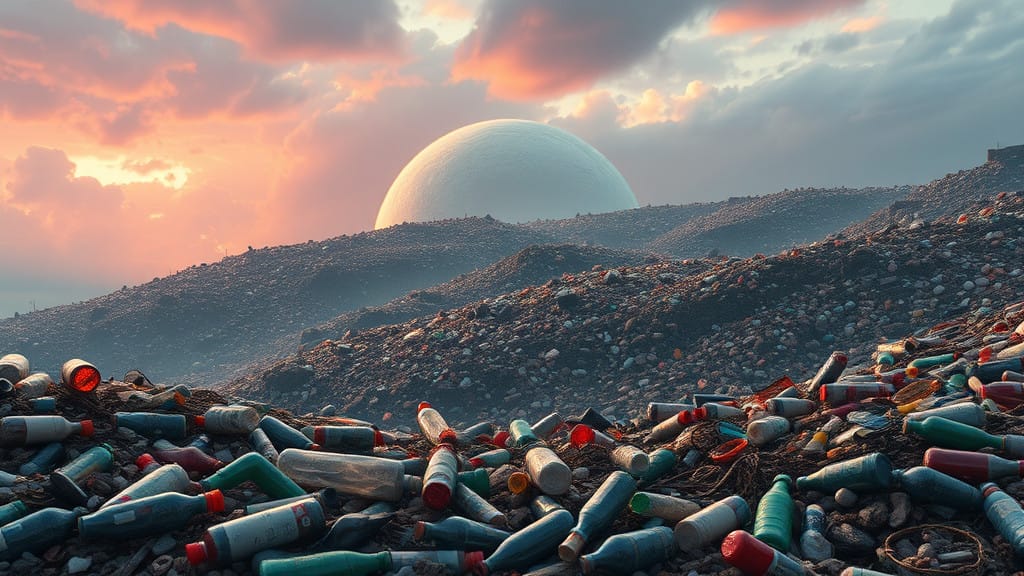
If you could un-invent something, what would it be?
Without doubt – Plastic.
If I had the chance, I would give everything to un-invent plastic. I would journey through the corridors of time to find those people, every single one — who dared to plant the seed of this idea. Though Leo Baekeland is credited with creating the first fully developed plastic, my search wouldn’t stop with him. I’d go further back, peeling through the layers of history to uncover the mind that first envisioned this synthetic curse disguised as innovation.
And look where we are now… This so-called marvel of human convenience has become the harbinger of destruction, tearing apart the delicate threads of life on Earth. It doesn’t stop at humans. Entire ecosystems are suffocating under the weight of this invention that should never have seen the light of day.
Well, let’s not forget plastic is also floating up in space.
How Our Everyday Actions Fuel the Plastic Epidemic
The innovation of the so-called brilliance and the implementation of the same by the industries… A state which you and I have no full control to manipulate in stopping their contribution with their world Plastic accumulation. The accumulation of Ignorance is where we have power over. Each small action, which seems innocent on the surface, adds to the plastic catastrophe. A single straw here, a forgotten wrapper there, a bag carelessly tossed aside. Multiply this by billions of people, day after day, and you begin to see the scale of the disaster.
- Plastic Bottles: Once praised for their convenience, now one of the biggest contributors to environmental ruin.
- Disposable Packaging: A fleeting utility that leaves behind a century-long scar.
- Microplastics: Invisible invaders in our water, soil, and even our bodies.
These seemingly inconsequential choices are piling up to create a legacy of waste that will outlive every one of us.
The Unforgivable Irony of Progress
Plastic was meant to symbolize advancement—lightweight, durable, and affordable. Yet in its resilience lies its greatest flaw. It does not break down, does not disappear. Instead, it clings to the planet like a parasite, infiltrating every corner of existence.
The irony deepens when you realize that even outer space isn’t free of plastic. Discarded rocket parts, defunct satellites, and fragments of human-made debris orbit the Earth, creating a cosmic graveyard of waste. Our carelessness isn’t bound to the planet; we’ve managed to pollute the heavens too.
What If We Could Go Back?
If I could step into a time machine, I wouldn’t hesitate. I would travel back to the moment the spark of plastic was lit. Not to praise it but to snuff it out before it could burn. Because while the world once applauded plastic as a miracle, history has revealed it as humanity’s greatest mistake.
We are not just endangering the life around us; we are gambling with the existence of life itself. If there is one thing we could undo, one creation to erase, it would be this: plastic. Without a doubt.
 A Solivagant's Shoes